Whenever I would reach the point in marriage preparation when it came time to talk about the ceremony and affirming their intentions according to the intentions of the Church and discussing their vows, I would usually begin by asking the couple if they could explain (apart from marriage) the difference between a contract and a covenant. Most people would say a contract is a legal agreement. At the same time, most would say they had no idea how to explain a covenant. When I asked them if they thought marriage is a contract, they would say, “Well, yes, I guess so.” When I asked them why, it was usually because they had to get a license that included their signature.
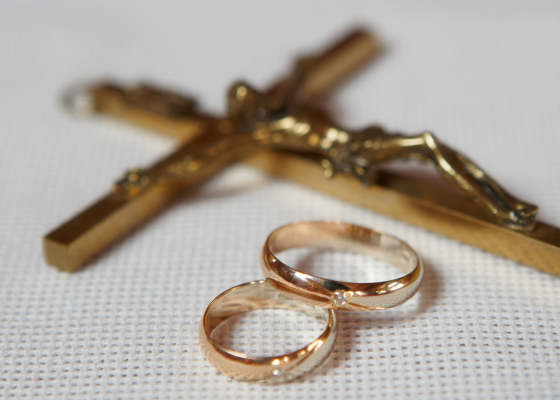
But the sacrament of marriage is not simply a legal agreement between two people. Doesn’t that seem like a very odd way to talk about the lifelong union of two people who are deeply in love? The covenant of marriage is so much more! It is an agreement among 3 people: the bride, the groom and Jesus. They pledge their love to each other before the Lord and the Lord pledges his grace to sustain them in this lifelong union and all that they will experience together in their relationship, and in the children who the Lord gives them from their union. Marriage is a rich covenant, not a sterile contract.
Holy Matrimony is a most profound vocation! In this sacrament, the Lord gives the bride and the groom, throughout their lives, the grace to “love one another as I have loved you,” Jesus said. So just what does this love look like? The love of Jesus for us, his bride the Church, is generous, sacrificial, unconditional, forever, faithful and fruitful. The grace of the sacrament of marriage enables the bride and the groom to love each other like that. In the wedding ceremony, the bride and groom pledge to love each other in this most profound way and receive the grace they need each day to put that love into practice.
As the bride and groom are about to exchange their vows, they are asked three questions. (The wording has changed slightly in recent years, but the questions are basically the same.) First, they are asked, “Have you come here freely and without reservation to give yourself to each other in marriage?” Jesus freely laid down his life for us, holding nothing back. Marriage is the free gift of man and woman to each other, holding nothing back. It has to be a free choice. This is why arranged marriages in some cultures are a problem if either party to the marriage does not freely enter a marriage that has been arranged for them.
Secondly, they are asked, “Will you love and honor each other as man and wife for the rest of your lives?”
Both of these are intentional decisions. I will love you means, I will desire what is good for you all the days of my life. To honor someone is to hold them with great respect. This means no girls night out when all in the group take turns revealing the faults of their husbands, and no group of guys playing one-upmanship in complaining about their wives. Some justify this as venting or just blowing off steam. No, you don’t get a pass on these promises every now and then. But I’ll come back to this shortly.
Thirdly, they are asked, “Will you accept children loving from God and bring them up according to the law of Christ and his Church?” Jesus surrendered his whole life for us, out of love. Those who marry surrender their entire lives to each other: body, mind and spirit. The fruit of their love is the gift of new life, and this must be a permanent openness to the totality of each other, including their fertility. To exclude any part of the gift of each other is to make the marital act a lie, because something is being withheld when Jesus withheld nothing out of love for us. Planning, naturally, the number and spacing of their children is prudent. But this needs to be done in cooperation with God, the third person in the marriage, and not in opposition to him.
The other part of the third question is, “Will you bring them [children] up according to the law of Christ and his Church?” There is a sacred obligation to give your children the gift of faith in baptism and a formation in that faith from that day forward. Baptism initiates a life of grace in a child. And parental teaching at home nourishes and forms their faith. Parents are always the first teachers of their children in the way of faith, and first and foremost by their example. The parish community provides a secondary formation, but that should come primarily from their homelife and the example of their parents.
Now, going back to the second intention above…To love and honor someone ALL the days of your life means even (and especially) on those days when your spouse is not very loving to you. Because, as St. Paul says, “While we were yet sinners, Christ died for us.” To love someone who may not always love and honor you is Christ-like. But that is precisely what heals the wounds of marriage. The crucifixion and death of Jesus healed the wound of original sin. When spouses love each other when it feels like they don’t deserve to be loved, it is to remind each other of another person’s unconditional love when he died on the cross for them. Isn’t that profound? And when you can do this over and over again with the same person even though their behavior patterns may repeat or never change, that is truly heroic love – which is what we all receive from the cross!
Okay, so this is getting a bit long! (Can you tell I am passionate about this stuff?) I get animated because I have seen it lived out so beautifully in the people in the parishes I have served. If you have been married with the blessing of the Church, no matter how recently or how very long ago, you have this capacity by God’s grace, to love your spouse in such a way that they see Christ’s love for them in how you love them. So lean into this grace! Ask the Lord to teach you how to love like he loves. That’s what marriage is as a covenant. It is so much more than most couples think about when they get married. It is so profound!