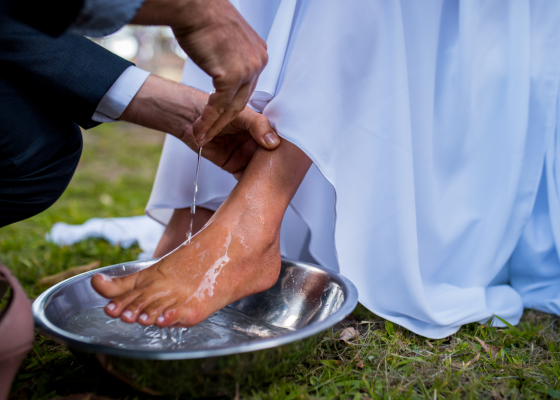
The scripture readings for Mass yesterday focused our attention on the virtue of humility. In the reading from the Book of Sirach, the sacred author says, “My child, conduct your affairs with humility, and you will be loved more than a giver of gifts. Humble yourself the more, the greater you are, and you will find favor with God.” Among all the virtues that we might practice, humility is not one that people often strive to acquire. After all, who wants to be humbled? Thus, pride is more prevalent than we realize. One simple humiliation in our lives can be devastating, especially when it takes place in a public setting.
According to the Book of Sirach, the more we humble ourselves, the more we will find favor with God. And the Gospel reminds us that “Everyone who exalts himself will be humbled, but the one who humbles himself will be exalted.” While we would like to believe the Lord at his word, it is pretty hard to accept humiliation in this life when the exaltation might not take place until “the resurrection of the righteous.” Often, we are tempted to believe that we can have both – worldly honor in this life and a place of honor in the life to come.
We tend to cringe when we hear gospel passages that say things like, “If they strike you on one cheek, turn and offer the other.” (Matthew 5:39) Rather, the culture teaches us to strike back, and not to put up with humiliation and disrespect. It is in those moments that we have to remind ourselves that God, who knows everything, will not forget our humiliations. In those moments, we will be exalted in his heart, and for all eternity in His Kingdom.
So, the challenge is how to get over the sting of humiliation. Whether it is someone cutting us off in traffic or ignoring us when we say hello to them or leveling some accusation against us wrongly, the sting can burn us for quite some time, especially if we nurse the resentment. Rather, when hurtful things happen to us and we experience humiliation, we can recover faster by remembering that Jesus also suffered in this way. Thus, if we unite our humiliations to the unspeakable humiliation of his passion – being stripped, scourged, mocked, spit upon and dishonored – we are no longer alone in these humiliations and Jesus gives us the strength to endure all things for love of him.
Three characteristics of this age make the age-old call to humility an important aspect of our spiritual lives. First, it is the current boldness and arrogance of our culture. Both talk radio and social media have created a world in which people are encouraged to have an opinion about everything…and to express it. Unfortunately, it is so often done with arrogance and not charity. Social media has taught us to be “thumbs up” or “thumbs down” about everything. Humility is NOT expressing an opinion about every single thing that happens in a given day. And true humility is not even forming an opinion in the first place.
Secondly, the call to humility is important because we have all grown more sensitive to the nasty comments of others. I never liked it when my mom would repeat the old saying, “Sticks and stone may break my bones, but words can never hurt me.” In fact, words hurt us much more deeply than sticks and stones, but we have to turn our sensitivity into prayer for the conversion of those who hurt us, rather than simply nurse resentment. We also have to pray for the grace to remember that what people often say is only their opinion and usually nothing more. Therefore, it should be dismissed at once.
And thirdly, the call to humility is important because we are simply unaccustomed to suffering. We avoid it at all costs. Look at how advertising sells us on the idea that we “deserve” everything. This sense of “entitlement” happens like osmosis. We seem to think that we should never suffer anything. The idea of “safe spaces” on college campuses is a case in point – that we should have places to go where we don’t have to hear what we don’t want to hear. Rather, the virtue of humility enables us to bear all things because we know we have already been exalted by God (in our baptism) as his beloved sons and daughters.
Most of us do not have to go looking for humiliation. Life humbles us somewhat regularly. At the same time, if our lives are lived for the praise and glory of God rather than the praise, honor, popularity, recognition of others, or to influence them, then we can take the humiliations that come our way because we know the truth of God’s love for us and base our response to life’s hurts on the exaltation that our Lord promises. May the Lord teach us how to suffer for love of him, so that he might exalt us beyond our imagination!