Recently, I finished a book published under the “Christian Classics” label from Ave Maria Press, Inc., entitled The Mystery of Suffering, by Rev. Hubert Van Zeller, O.S.B. It is just 104 pages, but it is filled with wisdom and solid Catholic teaching on the matter of human suffering. The first question that almost everyone asks when some physical pain or some material or emotional hardship comes their way is: why? Why is this happening to me? Or, what did I do to deserve this? It seems that we immediately want to understand or make sense out of what we are experiencing.
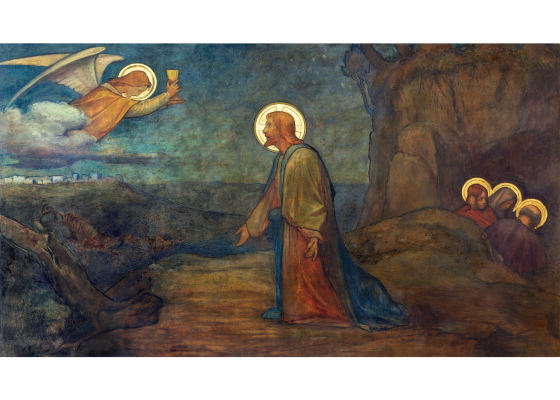
Van Zeller suggests that “Suffering and the providence of God have to be understood in faith… Providence in relation to our sufferings means simply this: that when we have to suffer, we can safely assume that God has allowed this particular trial for our sanctification.” Simply put, suffering is for our growth in holiness. That being said, we can only experience the grace of suffering when we accept the difficulties that come our way as a means of glorifying God. We see this in the garden of Gethsemane when Jesus asked that the cup of suffering might be taken from him, only then to say, “Not my will but yours be done.”
Van Zeller writes “Our aim is not to get through this life with the maximum of pleasure and the minimum of suffering. Our aim is to handle everything in this life, whether pleasurable or painful, in such a way that it becomes matter for the love of God…The important thing is to receive whichever it is (pleasure or pain) with love.” Psalm 34:1 says, “I will bless the Lord at all times: his praise shall continually be in my mouth.” Van Zeller writes, “When the gratitude has become habitual, always and everywhere covering pleasure and pain, it supposes the abiding love, which grace builds up in a responsive soul.”
My previous spiritual director, who died in March of last year, would often ask me, “Have you thanked God for the adversity?” It’s not something we naturally do, and yet it develops the idea of Psalm 34:1: to bless the Lord at all times. For if his praise is continually upon our lips, we are better prepared to accept and persevere through the challenges, sufferings, injustices, disappointments and pains of life. That we bless the Lord at all times, including life’s troubles, trains us to find God in all things and to offer back to him our acceptance of these trials out of love for him. In doing this we are being sanctified.
Van Zeller goes on to say that “Holy people know – and know it better than others – that suffering must anyway occupy a fair slice of life. They accept this as normal, meeting their sorrows as calmly and cheerfully as they can. They do not focus their attention on the necessity of suffering; they focus their whole attention on the necessity of loving. It’s just that they see the necessary place of suffering in the overall activity of love.” As an example, imagine a guy who goes to work every day at a nasty job but does it for 35 years out of love for his family, to provide for them. Love is his focus, not the suffering he has to endure.
Resignation to the will of God through suffering is more than obedience of a creature to his creator. Van Zeller says, “Man must also know that every time he wills to exercise obedience, he gives glory to God and furthers his own sanctification.” He notes, “Resignation in the true sense does not make people impervious, indifferent; it makes them hopeful. It means that they have refused to be defeated by their sufferings, and as a result, they come through with a deeper realization of what suffering is designed to do. Suffering has a cleansing effect on the soul….Resignation makes a man free of the preoccupations that harass the man who is forever complaining about his trouble and looking everywhere for a way out.”
This generosity moves us from resignation to acceptance. Van Zeller says that “The suffering is undergone not so much of necessity as in voluntary sacrifice. Jesus came not to do his own will but the will of his Heavenly Father. Van Zeller points out that, “His Passion happened to him but was willed by him.” The attitude of our Blessed Mother in saying “Be it done to me according to thy word,” reveals that Mary put herself at the disposal of God for better or for worse. In God’s plan, it was important that she should accept. Van Zeller says, “Hers was what might be called active receptivity, constructive acceptance.
Van Zeller writes, “Saving a special call of grace, it is not part of the Christian ideal to go looking for suffering….From resignation to willingness, from willingness to welcome. We are trying to show that receiving the cross with open arms is a laudable aspiration for any Christian.” As a priest, I have experienced in people every kind of response to suffering. I have seen people who are bitterly angry because of the suffering they say they did not deserve. Others may be resigned to what they cannot change but never accept the difficulty as an opportunity to draw closer to the Lord. And others choose to offer their suffering for the glory of God or as something for the benefit of others. During this Lenten season, may all that we suffer give glory to God and transform our souls in preparation for the glory that awaits us.