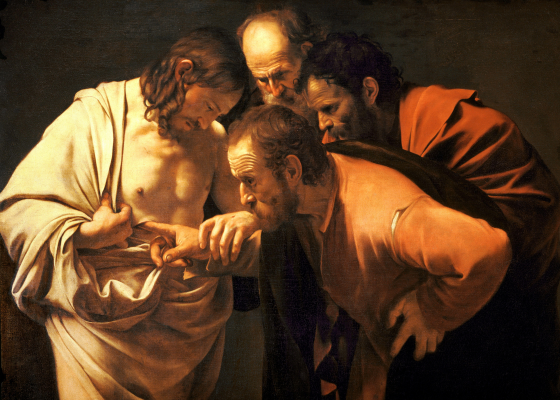
The Gospel story for this Second Sunday of Easter is the story of the apostle Thomas and his struggle to believe the testimony of others about the Resurrection of Jesus. When they bore testimony that Jesus had appeared to them after the Resurrection, he doubted them, utterly, saying, “Unless I see the mark of the nails in his hands and put my finger into the nail marks and put my hand into his side, I will not believe.” Thomas required proof of something so astonishing as the report that Jesus was alive again. He didn’t trust what he was being told, even by the other apostles. He insisted on verifying the report himself.
The next time Jesus appears to the apostles, Thomas is with them, and Jesus said to Thomas, “Put your finger here and see my hands, and bring your hand and put it into my side and do not be unbelieving but believe.” Jesus gave Thomas the opportunity to verify, firsthand, what he struggled to believe. The response of Thomas to Jesus was, “My Lord and my God!” It is perhaps from Thomas’s encounter with Jesus that we get the saying, “Seeing is believing.” Yet, I think the phrase should be, “Seeing is verifying what I struggle to believe.” Notice that Jesus then said, “Have you come to believe because you have seen me? Blessed are those who have not seen and have believed.” Ultimately, faith is a decision to believe.
What about the Catholic faith causes you doubts and uncertainty? What will it take for you to believe, to accept, to have the certainty of faith? I think of the words in the children’s song, “Jesus loves me this I know, for the Bible tells me so.” While this notion of believing something simply because it is found in Sacred Scripture might seem immature or even foolish, it is an act of faith to believe sacred scripture because it is the Word of God. For some, this is all the proof they need. For others, like the apostle Thomas, more is required.
In the Letter to the Hebrews (11:1) we read, “Now faith is confidence in what we hope for and assurance about what we do not see.” As humans, we have the unique ability to have confidence/believe in something we cannot prove or see. Take, for example, the certainty that one’s spouse loves them. Certainly, people demonstrate their love for each other in all kinds of ways. But strictly speaking, that doesn’t “prove” anything. Faith in the goodness, truthfulness and love of another person is a decision one makes to accept and believe. Having certainty without proof is faith. Certainty based on proof is not faith but simply verification. While verification is rational, Jesus said, “Blessed are those who have not seen and have believed.”
Perhaps as a spiritual exercise we could take some time to explore the kinds of doubts we experience when it comes to faith, to believing without seeing, to accept without proof of something in sacred scripture or in the teachings of the Church. Sometimes we balk at consenting to some doctrinal matter because we don’t agree with the teaching or we don’t want to put our lives in step with the doctrine. We plead that the matter is not a divine law from God but one made up by a bunch of churchmen. Rather than consent to the teaching we look for ways to sidestep the matter. Yet, rather than leave us at peace, we become irritated.
Perhaps St. Thomas gets a bad wrap for doubting, and yet it is a normal first response for many of us. Unfortunately, it often carries over to our trust in God’s love for us, as well. Many times, people don’t believe God loves them because of some guilt or shame in their lives, and yet Psalm 136 repeats over and over again, “For his love/mercy endures forever.” Likewise, St. Paul reminds us in Romans 8: 39, “No power in the sky above or in the earth below—indeed, nothing in all creation will ever be able to separate us from the love of God that is revealed in Christ Jesus our Lord.”
So how is it that God can PROVE his love for you? What would it take? For St. Thomas, it took a personal encounter. For us it can be the same – when we allow ourselves to be affected by the love God has for us in Christ. What will it take to convince you that you are precious in God’s eyes (Isaiah 43: 4), or as St. Paul says in Romans 5:8, “God proves His love for us in this: While we were still sinners, Christ died for us.”
Isn’t this why we often do the Stations of the Cross? By looking at our patterns of doubt, uncertainly, hesitancy to trust or when we decide that “God may love others, but he doesn’t love me,” we begin to see where we need to lean into our faith, not dismiss it.
Let us take to heart our Lord’s words to St. Thomas when he said, “Blessed are those who have not seen and have believed.” To grow in faith, it’s always good to read the entire book of the Acts of the Apostles during this Easter season. We discover in those chapters the unshakable faith of the apostles and others in the early Church after the Resurrection of Jesus, and especially after Pentecost. Where we experience doubts in our faith, it is especially there that we pray, “Jesus, help my lack of faith.” Indeed, it is by faith that we touch the nail marks and put our hands into his side. It is faith in the testimony of the apostles that conquers our unbelief!