There are a number of “unless” statements in sacred scripture, as well. Here are some examples: “As surely as Pharaoh lives, you will not leave this place unless your youngest brother comes here.” (Gen. 42:15); “However, I know that the king of Egypt will not allow you to go, unless he is forced by a strong hand.” (Exodus 3:19); “Unless the Lord builds the house, in vain do the builders labor.” (Psalm 127:1); “I tell you, no! But unless you repent, you too will all perish.” (Luke 13:3); “Unless I go away, the Advocate will not come to you; but if I go, I will send him to you.” (John 16:7); Jesus replied, “Very truly I tell you, no one can see the kingdom of God unless they are born again.” (John 3:3); “I assure you,” He said, “unless you are converted and become like children, you will never enter the kingdom of heaven.” (Mt: 18:3)
Yet among the 116 occurrences of the word “unless” in the various translations of the bible, perhaps the most profound among them is the one we just heard in Sunday’s gospel, from the Bread of Life discourse from St. John. For our Lord, himself, said: “Unless you eat the flesh of the Son of Man and drink his blood you do not have life within you. He who eats my flesh and drinks my blood has eternal life, and I will raise him on the last day.” (John 6:53-54) I think it is this particular “unless” in the Scriptures that has the greatest significance, because it brings eternal consequences! Thus, we ought to give it serious consideration.
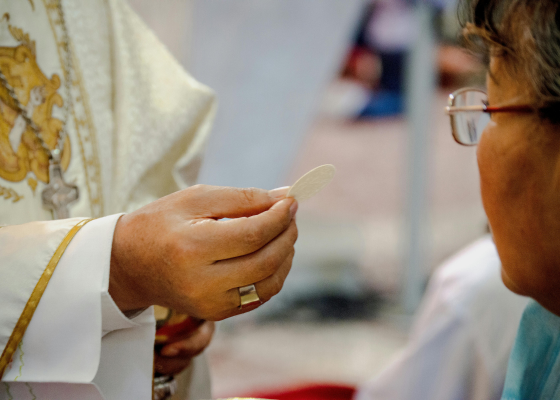
So, when is it that we “eat the flesh of the son of man and drink his blood?” It is only when we receive Holy Communion at Mass. In this moment, when we receive the Eucharist, we are doing perhaps the most significant human act possible: we are accepting our salvation – which is the gift of eternal life! What could be more meaningful than to receive the pledge of life after death in the Resurrection? Truly, it is incomprehensible what takes place when we receive the Body and Blood of Christ. If we could visibly see the effects of receiving Holy Communion in a worthy manner, we would be overwhelmed!
At the same time, “unless” we regularly reflect upon this sacred mystery, our eucharistic practice risks becoming routine and even discontinued. In that regard, many outsiders looking in on the Catholic faith have said things like, “If you Catholics really believed that you are receiving the actual body and blood of Jesus, you would be crawling on your knees to take Holy Communion.” Now, because we don’t crawl up the aisle to receive Holy Communion doesn’t mean we don’t really believe in the real presence of our Lord in the Eucharist. It is our faith that supplies what our minds are unable to comprehend.
Nevertheless, we would do well to regularly reflect upon these words of our Lord so that our minds and hearts don’t become indifferent to the beauty of this most sacred gift. Perhaps that is why the Lord gives us this teaching with the word “unless.” Unless we receive Holy Communion, we are lacking something. And what we are lacking is nothing less than the divine life of Jesus animating our bodies, minds, hearts and souls. Simply put, without receiving the Body and Blood of our Lord, we are operating on our own. We do not have HIS life within us. Without being judgmental, we experience the difference all around us.
Jesus adds this: “He who eats my flesh and drinks my blood has eternal life and I will raise him on the last day.” (John 6:54) Without the reception of Holy Communion, we also risk losing the gift of eternal life in the Resurrection, when our Lord “comes to judge the living and the dead.” This “unless we eat and drink” the precious Body and Blood of Christ implies that without receiving the Eucharist we may not reach our heavenly home. But for those who do, we ALREADY HAVE a foretaste of eternal life and the pledge of our salvation. Just as during the first Passover in Egypt when the blood of the lamb marked the door posts of the Israelites, so now, the Blood of Christ marks our lips every time we receive Holy Communion!
For this reason, it is important not only to bring new people to the Church but to also welcome back to Mass those who have become distant from the Church, as well. If we believe this “unless” statement of our Lord with regard to his precious Body and Blood, would we not want everyone to know and experience the divine life that our Lord promises, both now and in his Kingdom that will have no end? In fact, the more deeply we appreciate the intimate communion of life and love we have with our Lord in the Eucharist, the more readily we will share our faith in this eucharistic mystery with others.
But it is important that we do so not by laying on them the threat of the loss of heaven and the pains of hell, but by witnessing to them the joy and hope that we have because of the Eucharist. This is why the U.S. Bishops initiated a Eucharistic revival nearly 4 years ago leading up to the National Eucharistic Congress in July of 2024. We don’t go around telling others that they ought to come back to Mass. Rather, we confidently tell them why we are there, and what it means to us. We simply bear witness to the vitality of our faith, nourished at the table of the Lord, and then say, “…and I would like to share this with you.” May others come to believe because we do.